Home / Guides / Muscle Volume and Recovery
How Many Sets Per Muscle Per Week? Volume and Recovery, Explained
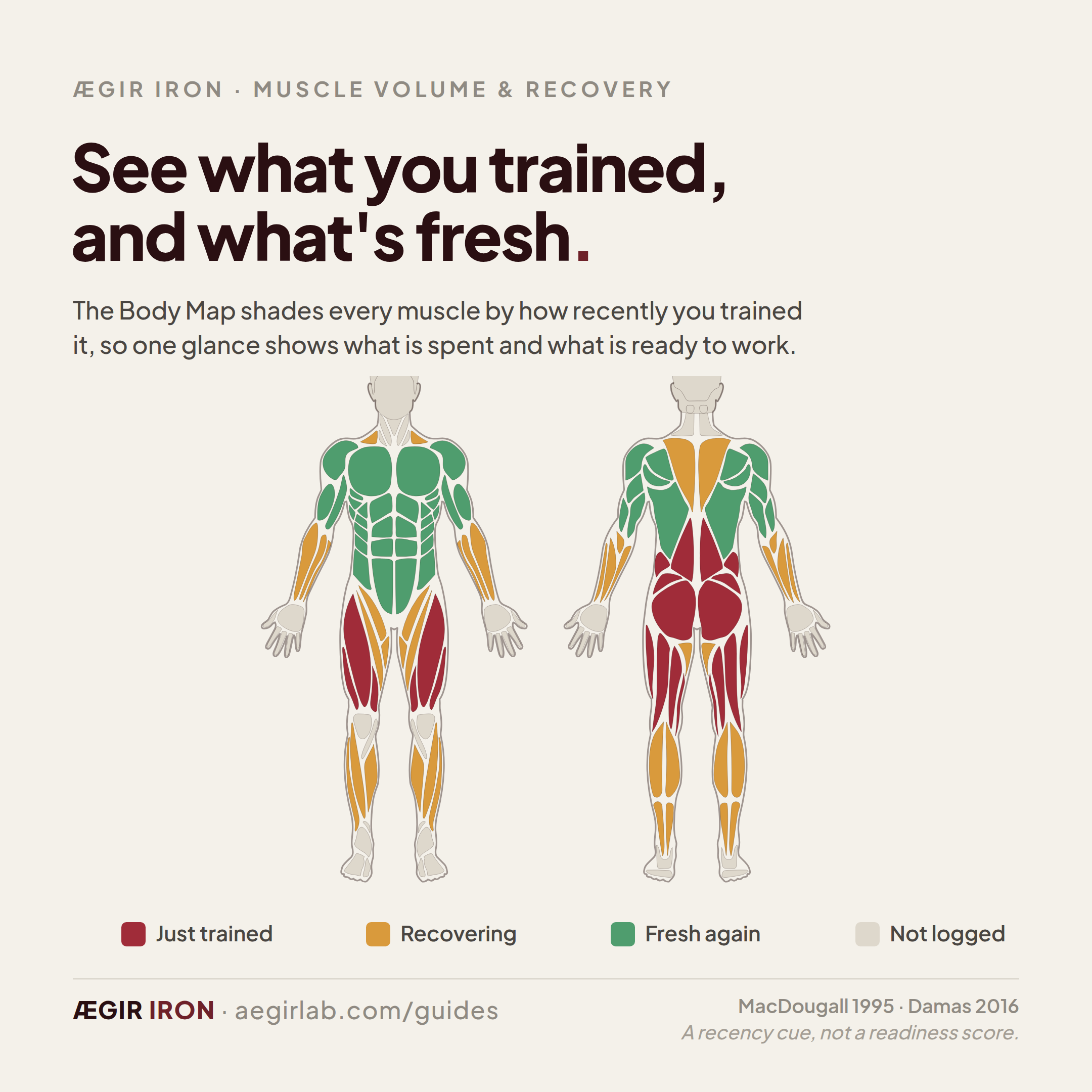
Ægir Iron's Body Map colors an anatomical figure two ways: which muscles you've hit recently, and which ones are actually getting enough work. Both come straight from the sets you log. Here is exactly how the counting works, how much volume you really need, and the real limits of what a recovery color can tell you.
Counting sets the way muscles feel them
Most volume trackers count exercises by their name: a "chest day" adds to chest, a "back day" adds to back. That misses how compound lifts actually distribute stress. A heavy deadlift trains your glutes and hamstrings hard, your lower back and grip nearly as hard, and your quads a fair amount, none of which have "deadlift" in the name.
So the Body Map uses fractional set counting: one set credits every muscle it trains, weighted by how much that muscle is involved. The main movers each score close to a full set, and a lift can have several: a hinge like the deadlift is driven by the glutes, hamstrings and erectors together, so all three score high, while lighter helpers score a fraction. A 2025 meta-regression that classified every training set as direct or indirect found this fractional approach had the strongest support of the methods it tested (Pelland et al., 2025; the concept was formalized earlier by Schoenfeld et al., 2019). The specific involvement weights below are Ægir Iron's own estimates, not published values. One deadlift set is not one unit of "back," it is a spread:
A few rules keep the count clean. Warm-up sets and missed attempts don't count, because training volume in the research is measured as hard working sets, not ramp-ups, and a missed rep moved no load. Every working set counts the same regardless of weight on the bar, which is deliberate: across a wide load range, sets taken close to failure drive similar muscle growth (Morton et al., 2016), so the real currency is the hard set, not the tonnage. The one assumption baked in is exactly that, that your working sets are taken reasonably close to failure. A set left five reps short stimulates less than the count implies.
How many sets per muscle per week?
Once sets are counted per muscle, the Volume view compares your trailing 7 days against a weekly target. The anchor is the classic finding that roughly 10 hard sets per muscle per week is a productive dose for most trainees (Schoenfeld, Ogborn and Krieger, 2017). Two refinements sit on top of that number.
First, 10 is a floor, not a ceiling. A 2025 meta-regression found that more weekly volume almost certainly kept adding muscle, with no clean plateau (Pelland et al., 2025), so hitting the target means "adequately trained," not "maxed out." Two caveats sit on top of that. One: these are effective sets, counted fractionally, and our involvement weights run a little more generous than the flat 0.5 the research uses for indirect sets, so you clear 10 effective sets somewhat faster than the plain counting behind the original number. It still sits comfortably inside the studied range (that analysis averaged around 12 sets a week), so the floor holds. Two: the dose-response differs by goal. It is best supported for muscle size; for maximal strength the returns diminish much sooner (in the same analysis muscle size kept climbing with no clean plateau even past 20 sets per muscle, while strength gains largely flattened by roughly 5 hard sets of the lift itself). The exact 10 / 8 / 6 tiers are our own coaching convention, not a research finding. Second, and this is where a lot of trackers get it wrong, the target is not just a function of muscle size. Smaller muscles don't need less volume. If anything the opposite is true for the arms: the big compound lifts only credit them fractionally, so they need close to a full slate of direct sets to accumulate a real dose. What actually varies the target is how much indirect work a muscle already collects from the big lifts:
| Weekly target | Muscles | Why |
|---|---|---|
| ~10 | Chest, shoulders, lats, glutes, quads, hamstrings, biceps, triceps | Prime movers, plus the arms. Compounds credit the arms only partially, so they need the full dose of direct work. |
| ~8 | Abs, traps, lower back, calves | Some indirect stimulus from bracing, deadlifts and carries, but still need dedicated work. |
| ~6 | Forearms, obliques, adductors | Collect heavy synergist volume from every pull, carry, squat and brace, so they reach an adequate total with fewer dedicated sets. |
The map shades each muscle below half its target red (train these next), between half and full amber, and on target green, over a trailing 7 days for the quick read and eight weekly buckets for the trend. It's a balance check, not a prescription: your own best volume shifts with your goals, experience and recovery, so use it to catch the group you've quietly neglected, not to chase a number.
What "recovery" really means here
The second view shades each muscle by how recently you trained it: just trained the day you hit it, recovering for about two days, fresh again after roughly three. It answers a genuinely useful question, "what have I hit lately, and what's fresh to train today," and it's worth being precise that this is a training-recency cue, not a physiological recovery measurement.
Why "recency" and not "recovery"? Because true recovery isn't one flat number. It scales with how heavy and how high-volume the session was, and it scales with training itself: through the repeated-bout effect, a trained lifter bounces back faster than a beginner from the identical session, as protein synthesis returns to baseline sooner and decouples from muscle damage with training (Damas et al., 2016). Our curve is the same three days for every muscle and every lifter, on purpose, because the alternative is pretending to measure something the app can't see (your sleep, your stress, your nutrition, your training age). Read it as "this group is fresh to hit again," and it's reliable. Read it as "I am 33% recovered," and it's promising more than any recency timer can deliver.
The blind spots, stated plainly
A metric is only trustworthy if you know where it stops. Three limits we'd rather name than hide:
- Shoulders are a single group. Front, side and rear delts are trained by completely different movements, but the figure has one deltoid region, so they share one read. A pressing-heavy week can show shoulders as well trained while your rear delts, the head most people actually neglect, are getting almost nothing. Splitting them is on our list.
- Recovery is effort-blind and load-blind. A top single and a brutal set of twenty read the same on the recency clock. Heavy, high-volume work genuinely recovers slower than the flat curve shows.
- Volume assumes hard sets. Sets counted as volume are assumed to be near failure. Junk sets left well short still add to the count but not to the stimulus.
Using it for powerlifting, weightlifting and strongman
For strength athletes the map is a balance check running quietly under a program built around the main lifts:
- A squat, bench and deadlift week lights up legs, back and chest, and often shows the upper back, rear delts and direct arm work drifting under target, the classic accessory gaps.
- Weightlifters can confirm the pulls and squats are covering the posterior chain while catching whether the overhead and midback work is actually there.
- Strongman's carries and presses spread stress across grip, traps and core, and the map shows when an events-heavy block has quietly starved a muscle that only direct work reaches.
Where it fits with your other numbers
Volume per muscle answers "what am I neglecting." It sits alongside the reads that answer the other questions: your acute-to-chronic workload ratio and its EWMA companion for whether your total load is ramping too fast, and relative intensity for whether you're actually training heavy enough, since two sessions can share a set count and a tonnage yet be nothing alike in intensity. Together they describe a block from four angles that tonnage alone can't.
The easiest way to track sets per muscle
You can keep a per-muscle set tally in a spreadsheet, but fractional counting across every compound lift, week after week, is exactly the bookkeeping that gets abandoned by February. Ægir Iron maps every set you log to the muscles it trains, shows weekly sets against a target and a recovery heat map on a real anatomical figure, and does it across powerlifting, weightlifting, strongman and general strength work, all from the sets you already record. If you want the picture without the tally, that's what it's built for.
Common questions
How many sets per muscle per week should I do? About 10 effective sets per muscle per week is a well-supported productive dose for most trainees, and a 2025 meta-regression found more volume almost certainly keeps adding muscle with no clean plateau (Pelland et al., 2025), so treat 10 as a floor. These are effective sets, counted fractionally, so compounds credit each muscle in proportion to involvement. Direct-work muscles like the arms and calves need close to the full amount because compounds only credit them partially; muscles that get heavy indirect work from squats, deadlifts, pulls and carries reach an adequate total with fewer dedicated sets. Two caveats: our involvement weights run a little more generous than the flat 0.5 the research uses for indirect sets, and the floor is best supported for muscle size, while maximal strength shows sharper diminishing returns. The 10/8/6 tiering is our own coaching convention.
Do compound lifts count toward every muscle they train? Yes. One set credits every muscle it trains, weighted by involvement, so a deadlift counts fully for the glutes and most of a set for the hamstrings, lower back, traps, quads and grip. Your weekly total per muscle is an effective count, not just the lifts named after it. A 2025 meta-regression validated the fractional approach (Pelland et al., 2025); the involvement weights themselves are Ægir Iron's own estimates.
How is muscle recovery calculated? Each muscle is shaded by how recently you trained it: just trained the day you hit it, recovering for about two days, fresh again after roughly three. It's a training-recency cue, not a physiological recovery measurement, and deliberately the same flat timeline for everyone, so treat it as a guideline rather than a readiness score.
What app tracks sets per muscle per week? Ægir Iron maps every logged set to the muscles it trains and shows weekly sets per muscle against a target, plus a recovery heat map, for powerlifting, weightlifting, strongman and general strength training, with no spreadsheet to maintain.
References
- Pelland JC, Remmert JF, Robinson ZP, et al. The resistance training dose response: meta-regressions exploring the effects of weekly volume and frequency on muscle hypertrophy and strength gains. Sports Med. 2025.
- Schoenfeld BJ, Contreras B, Krieger J, et al. Calculating set-volume for the limb muscles with the performance of multi-joint exercises: implications for resistance training prescription. Sports. 2019;7(7):177.
- Schoenfeld BJ, Ogborn D, Krieger JW. Dose-response relationship between weekly resistance training volume and increases in muscle mass: a systematic review and meta-analysis. J Sports Sci. 2017;35(11):1073-1082.
- Morton RW, Oikawa SY, Wavell CG, et al. Neither load nor systemic hormones determine resistance training-mediated hypertrophy or strength gains in resistance-trained young men. J Appl Physiol. 2016;121(1):129-138.
- Androulakis-Korakakis P, Michalopoulos N, Fisher JP, et al. The minimum effective training dose required for 1RM strength in powerlifters. Front Sports Act Living. 2021;3:713655.
- Androulakis-Korakakis P, Fisher JP, Steele J. The minimum effective training dose required to increase 1RM strength in resistance-trained men: a systematic review and meta-analysis. Sports Med. 2020;50(4):751-765.
- MacDougall JD, Gibala MJ, Tarnopolsky MA, et al. The time course for elevated muscle protein synthesis following heavy resistance exercise. Can J Appl Physiol. 1995;20(4):480-486.
- Damas F, Phillips SM, Libardi CA, et al. Resistance training-induced changes in integrated myofibrillar protein synthesis are related to hypertrophy only after attenuation of muscle damage. J Physiol. 2016;594(18):5209-5222.